
Jolly Phonics Group Six: Sounds, Actions and Words to Read
Group Six of Jolly Phonics teaches the sounds y, x, ch, sh, th (voiced), th (unvoiced). Each sound comes with a story, an action and a song to help your child remember it, then gets used straight away for blending into real words.
The 6 Sounds in Group Six
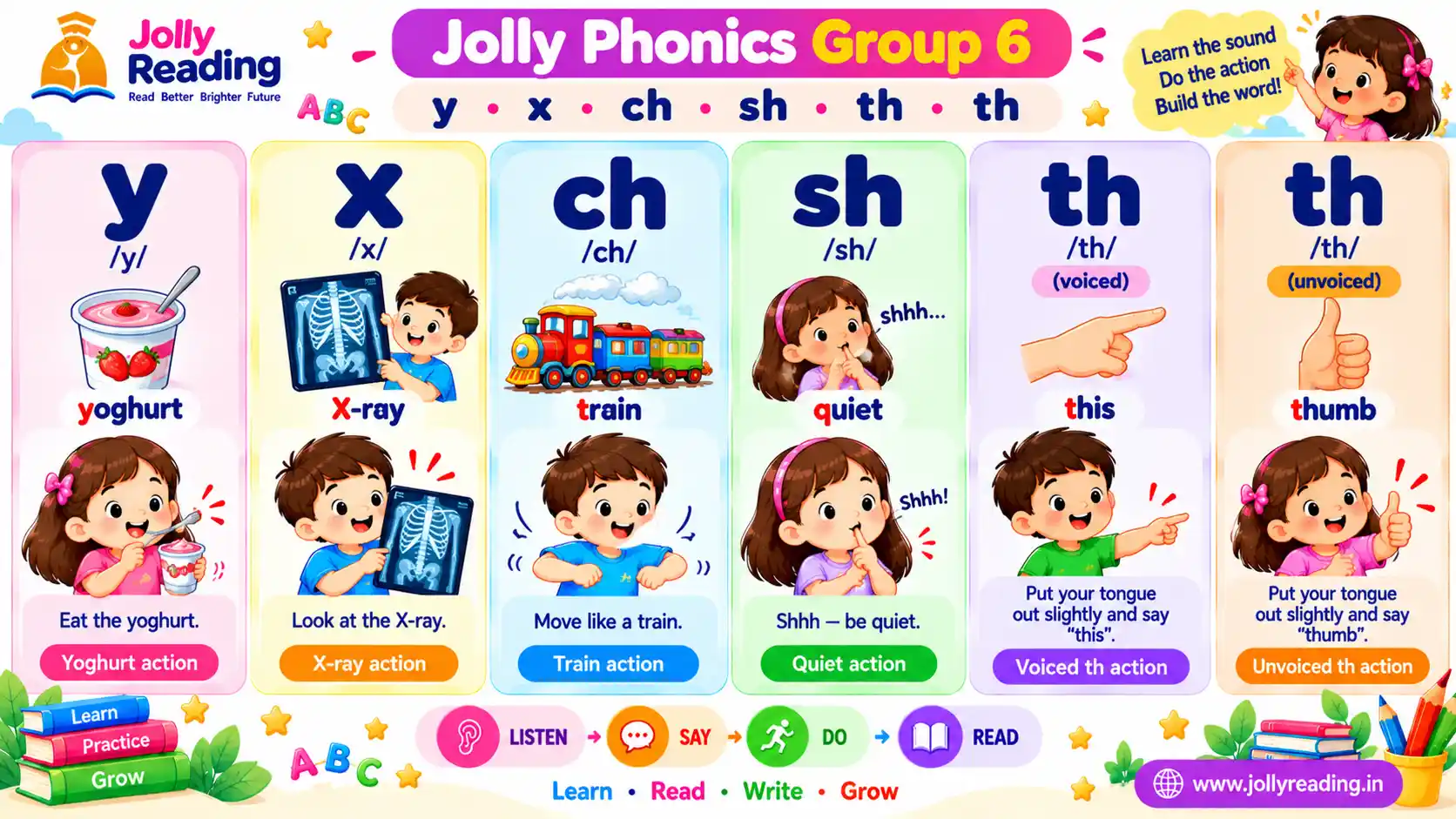
yoghurt
Eat the yoghurt
X-ray
Look at the X-ray
train
Move like a train
quiet
Shhh — be quiet
this
Put your tongue out slightly and say "this"
thumb
Put your tongue out slightly and say "thumb"
Jolly Phonics recommends starting tricky words once children can blend confidently — guidance points to starting from about the /sh/ lesson in this group. By the end of Group 6, all the common digraphs are covered.
Words Your Child Can Read After This Group
With almost all 42 sounds now covered, your child can read a huge range of words, including:
Sounds in This Group Children Often Find Hard
th (voiced and unvoiced)
Often said as /t/ or /d/, so thin becomes "tin". Tongue tip lightly between the teeth, then blow air for thin, or add voice for this.
Practising Group Six at Home
- One sound a day, with two minutes of revision of everything learned so far.
- Say pure sounds, not "suh" or "tuh" — see our full guide to how to say each sound correctly.
- Use the action every time. It's a memory trigger, not just for fun.
- Blend as soon as you have three or four sounds from this group — don't wait until the whole group is finished.
This fits inside our full 15-minute daily phonics routine, part of the complete guide to teaching phonics at home.
Frequently Asked Questions
What sounds are in Group 6 of Jolly Phonics? +
Group 6 is y, x, ch, sh, th (voiced), th (unvoiced).
What words can my child read after Group 6? +
Words such as yes, box, chin, ship become readable, along with any words combining these sounds with sounds from earlier groups.
How long should we spend on one group? +
Most children learn about one new sound a day with daily revision, so one group takes roughly a week, followed by ongoing practice while moving on to the next.
Should we move on if my child hasn't mastered every sound yet? +
A little unevenness is normal. If your child is clearly stuck on more than one sound in the group, spend a few extra days revising before moving on, rather than pushing ahead.